
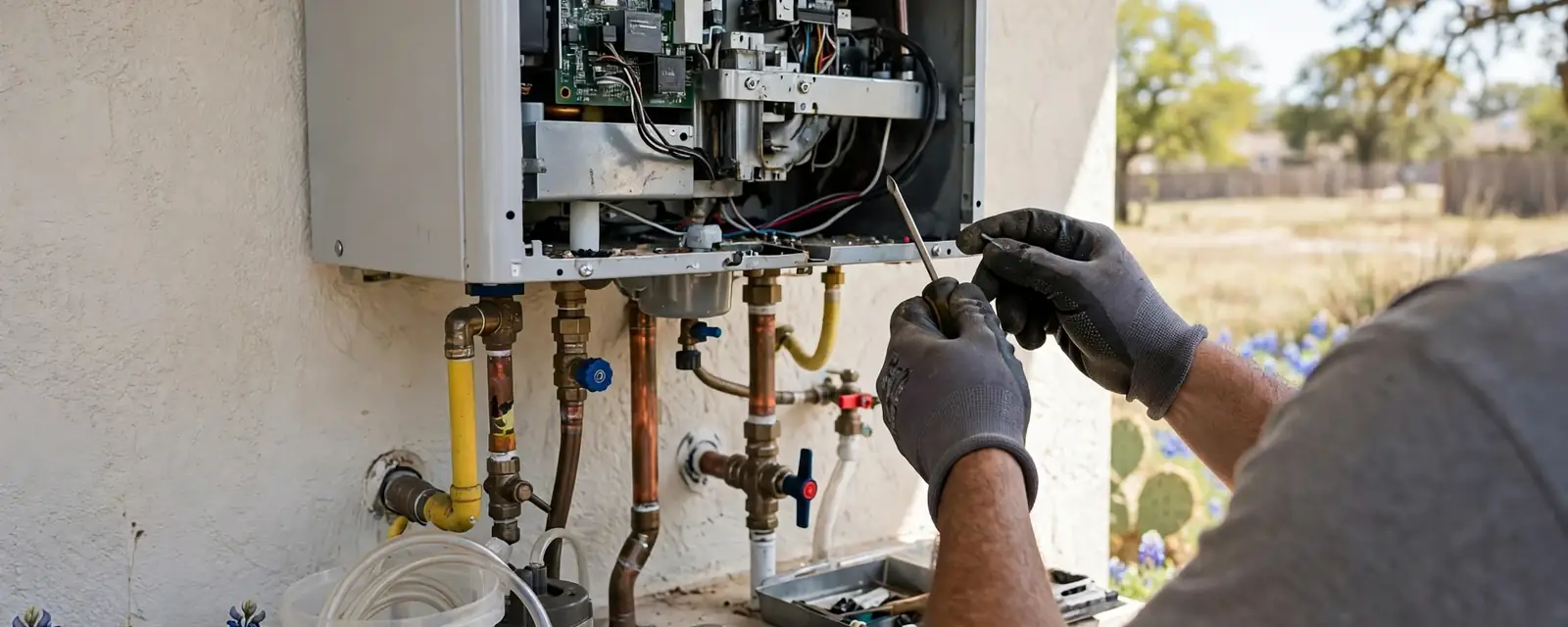
Wiring a tankless water heater is mostly an electrical planning job, because an electric unit can draw far more current than a tank heater. The wiring typically involves a dedicated circuit, heavy-gauge conductors, the right breakers and enough spare capacity in your main panel. Getting that wrong can trip breakers, overheat wire or void the warranty.
This guide is for planning and for talking to a contractor. It does not give wire gauges or breaker sizes for your unit, because those come from the manufacturer's instructions and a licensed electrician's load calculation, not from a blog post.
Why tankless wiring is a different job
A tank heater stores hot water and heats it slowly with a modest load. A tankless unit heats water on demand, so it needs a lot of power for a short time. That demand can be several times what a tank heater draws, and many older panels were never built for it.
Gas tankless units use a small amount of power for controls and a large amount of gas, so their wiring needs are minor. This guide is about electric models, which are the ones that stress the panel.
| Item | Electric tankless | Gas tankless |
|---|---|---|
| Main demand | Heavy electric load on dedicated circuits | Gas supply, venting and a small outlet. |
| Panel impact | Often needs spare capacity or a panel upgrade | Usually little. |
| Venting | None | Required, sized by manufacturer. |
| Gas line | None | May need a larger line. |
| Who does the work | Electrician plus plumber | Plumber plus gas and venting work. |
What to check before you buy
Questions to settle first
Bring the model's installation manual to every contractor you talk to. The numbers in it govern the job.
- How many amps does the unit need, and does the manufacturer require one circuit or several?
- How much spare capacity does your main panel have?
- Is there room in the panel for the new double-pole breakers?
- Where will the unit mount, and can wire reach it without a long run?
- Does the unit's flow rate match your household's peak use?
Sizing the unit is its own question. The right unit depends on how many fixtures run at once and how cold your incoming water is. Our page on tankless water heater service explains how sizing and service work.
What the wiring work includes
The stages of an electric tankless install
Each stage is done by a licensed professional.
Purge the air before you ever switch on the power
Electric tankless units can burn out their heating elements if power is applied before water flows through them. The standard practice is to open a hot faucet, let the unit fill and run until steady flow shows the air is gone, and only then turn the breaker on. If your installer skips that step, ask why.
The same logic applies after any repair that drains the unit.
Planning a tankless swap?
Call (770) 214-4545. We will talk through sizing, the plumbing side and what your electrician will need to check.
Smyrna note: permits and licensed trades
The City of Smyrna's Building Division says a permit is needed for projects involving two or more licensed trades. A tankless install that adds new electric circuits alongside plumbing work often involves two trades. The page does not list plumbing jobs line by line, so ask the division whether your project needs a permit. The Community Development Department can be reached at (678) 631-5387.
Permit applications go through the city's online portal, and inspections are scheduled there. The city has adopted the 2024 International Plumbing Code (IPC) with Georgia amendments, which is what plumbing inspections rely on. Ask your contractor who will pull the permit.
Why this is not a weekend project
Mistakes here are expensive and dangerous. Undersized wire overheats. A breaker that is too small trips constantly, and one that is too large fails to protect the wire. A loose terminal on a high-load circuit can melt insulation over time.
Georgia licenses plumbers through the Secretary of State's Division of Master and Journeyman Plumbers, and you can check a license in the GOALS portal. Electricians are licensed separately. Verify both before work starts.
Questions to ask a contractor
Ask who is responsible for the load calculation and whether the quote includes panel work or only the unit. Ask what happens if the inspector or the manufacturer requires a change after the work starts. Ask for the model number in writing so you can compare the quote to the installation manual.
Ask how the old tank will be removed and how the gas or electric connections will be capped. Ask whether isolation valves for flushing are included, since a tankless unit needs periodic descaling to keep its heat exchanger clean.
Costs and timing
The price depends on the unit, the panel work, the length of the wire run and the plumbing changes. A swap in a home with a strong panel costs less than one that needs a service upgrade. We give a clear price before work starts for the plumbing side of the job.
For the full process from removing a tank to final testing, read about water heater installation. We take calls across Smyrna and the towns on our service area page, and homeowners near Mableton can see our Mableton page.
Tankless wiring questions
Often not. Electric tankless units usually need more capacity than a tank heater circuit provides. The manufacturer's manual and an electrician's calculation decide.
Sometimes. If your panel lacks capacity for the added load, an upgrade may be required before the unit can go in.
Yes. Gas models need little electrical work, though they need proper venting and gas supply.
A licensed electrician should handle the circuits and panel work, and a licensed plumber should handle the water connections.
The city requires a permit for projects involving two or more licensed trades. Ask the Smyrna Building Division at (678) 631-5387 whether your project qualifies.
Have a plumbing problem right now? The line is open 24/7.
Call (770) 214-4545