
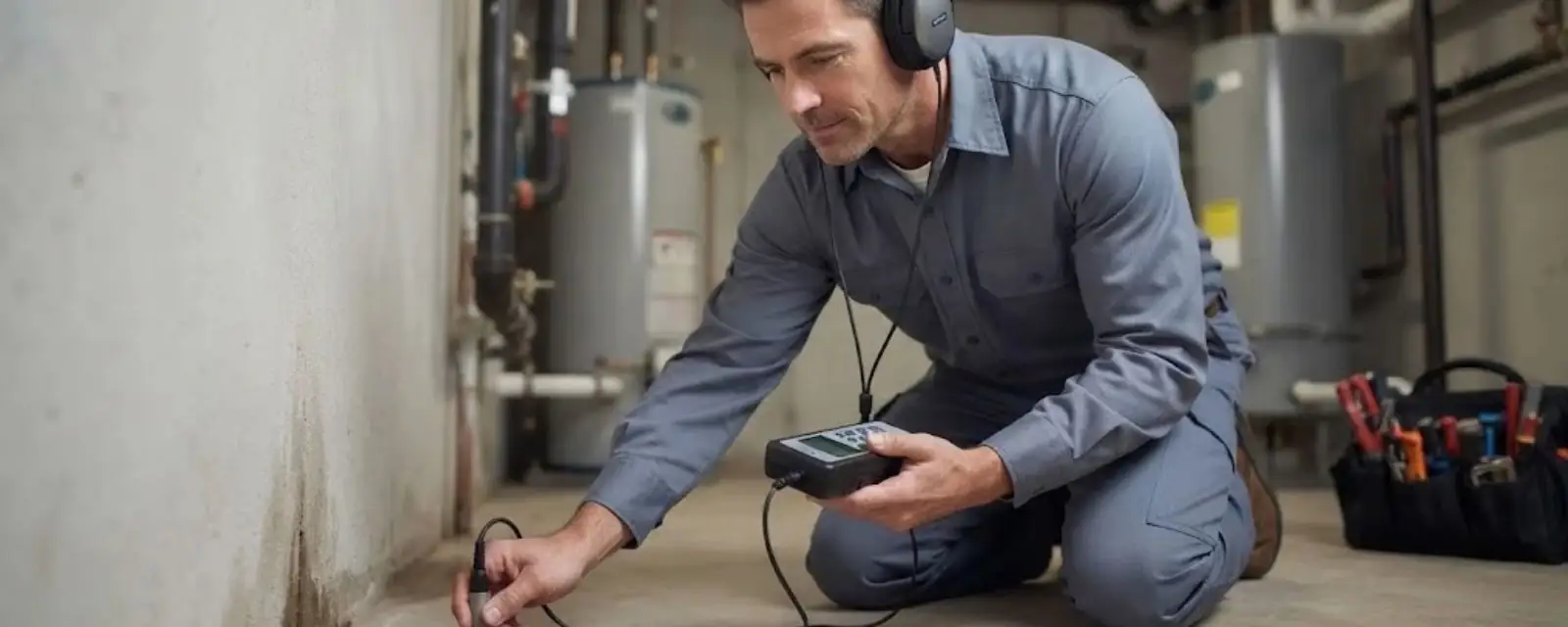
Emergency leak detection in Smyrna, GA begins with a symptom, not a tool. The water meter is moving when every tap is off. A stain is spreading on a ceiling. A floor feels warm in one spot, or the bill jumped with no change in habits. The 24/7 line takes these calls at any hour, so do not wait for a stain to become a collapse.
While you wait for the plumber, find the main shutoff valve and close it if water is actively coming through a ceiling, wall or floor. Turn off power to wet areas only if you can reach the panel without standing in water. Then leave the wall alone, since opening it before the leak is located can hide the source.
When a hidden leak is an emergency
A hidden leak is urgent when water is visibly spreading, when a ceiling is bulging, or when the meter is spinning fast with everything off. It is also urgent when you hear running water inside a wall at night. Each hour adds water to drywall, insulation and framing.
A slower leak is still worth a prompt visit. Water that seeps into a wall cavity for weeks feeds mold and rots wood quietly. Finding it early usually means a small repair instead of a rebuild.
The meter is still turning and nothing is running
This is the single most common way a leak announces itself. Shut off every tap, the ice maker and the washer, then watch the meter. If the small dial or the low-flow indicator keeps moving, water is leaving the house somewhere.
Where the leak sits decides who pays and who fixes it. The Cobb County Water System guide says the property owner is responsible for all piping and fixtures on the customer's side of the meter, and describes the meter as set at the edge of the property. Smyrna buys its water from the Cobb County-Marietta Water Authority, so confirm meter details with the Smyrna Utilities Department at 678-631-5338.
A simple split test narrows it quickly. Close the main shutoff at the house and watch the meter again. If it stops, the leak is inside the house. If it keeps moving, the leak is on the buried line between the meter and the house.
Symptoms we hear about most often
Any one of these is enough to call. Several together point to a leak that has been running a while.
- A water bill that crept up for several months with no change in use.
- The meter dial moving while every fixture is off.
- A damp, discolored or bubbling patch on a ceiling or wall.
- A warm spot on the floor, or the sound of running water behind a wall.
- Low water pressure that appeared without warning.
- A soggy patch of yard that stays wet in dry weather.
How we find a leak without opening every wall
Detection is a process of elimination. We isolate sections of the system with pressure tests, then use equipment to narrow the location to a small area. Only then does anyone cut into a wall or dig in the yard.
| Tool | Finds | Best used for |
|---|---|---|
| Acoustic listening | The sound of pressurized water escaping | Pipes in walls, under floors and underground. |
| Moisture meter | Hidden dampness in drywall, wood and subfloor | Confirming a stain's source and spread. |
| Thermal imaging | Temperature differences from wet or hot-water lines | Warm floor spots and wet insulation. |
| Pressure testing | Whether a supply line holds pressure | Splitting the house from the buried line. |
| Pipe camera | Cracks and breaks inside drain lines | Drain leaks and sewer line problems. |
Ceiling and wall leaks
A ceiling stain is rarely directly under the leak. Water travels along joists and pipes before it shows, so the source can be several feet from the mark. Moisture mapping and a listening pass trace the water back to its origin.
Common sources include a leaking supply line to an upstairs bathroom, a failed shower valve, a drain connection that dripped slowly, and condensation on an uninsulated line. We confirm which one it is before opening anything, so the hole in the drywall is as small as it can be.
Leaks under the house and in crawlspaces
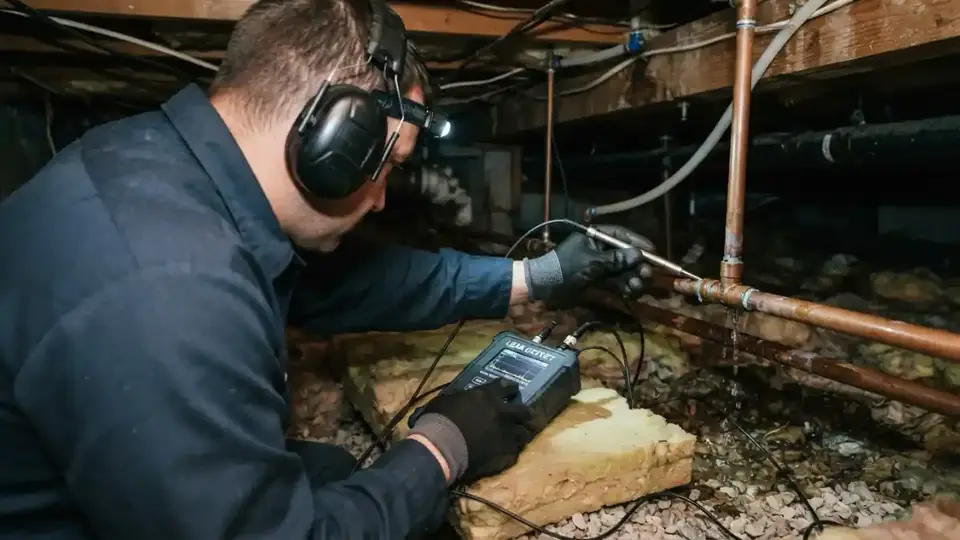
Under-house leaks are easy to miss because nothing shows inside. Signs include a musty smell, sagging insulation, damp soil under the floor, and a bill that rose with no stain anywhere. Supply lines and drain lines can both leak down there.
We inspect the crawlspace or basement, check insulation and soil for dampness, and run listening and pressure tests on the lines above. If the leak is in a drain line rather than a pressurized supply, a camera helps. For a house on a concrete foundation, see our slab leak repair page.
Leaks on the buried line between the meter and the house
A leak on the service line is on your side of the meter, so under the county guide the repair is the owner's. Confirm how that applies to your address with your utility. These leaks are silent. There may be no stain indoors at all, just a meter that moves and a patch of yard that stays soft.
We use acoustic equipment on the line to pinpoint the leak, then mark the spot so the dig is a small one. Call 811 before any digging so buried utilities are marked. 811 is the national call-before-you-dig number, and Georgia 811 serves this state.
Irrigation, pool and yard leaks
Irrigation leaks hide in zone valves and buried lines. A zone that stays wet, a sprinkler head that will not stop weeping, or pressure that drops when the system runs all point there. We isolate the zone and test it, and separate irrigation from the house supply so you know which one is actually losing water.
Pool and spa leaks are a smaller part of the calls we see, and we say plainly where our work ends. We can test the plumbing lines serving the equipment, and a pool builder or service company should test the shell. Soft ground around the meter box or a wet cleanout cover in the yard is a separate clue, often a fitting that has loosened.
What Smyrna's water supply and housing mean for leaks
Smyrna's water comes from the Cobb County-Marietta Water Authority, which draws on Lake Allatoona and the Chattahoochee River. The city's own report names the Smyrna Utilities Department as the contact, so a billing question or a suspected meter problem starts there, not with a plumber.
Smyrna grew from 2,005 residents in 1950 to 19,157 in 1970, so many houses date from the early postwar decades. Galvanized supply lines from that era corrode inside and eventually pinhole. If your home is in that age range and you have found one leak, ask us to test the rest of the supply system.
Cobb County's water report notes that lead in tap water mainly comes from service lines and home plumbing, and recommends flushing the tap before drinking. If we replace a section of older line, ask the plumber what material is going in.
Pipe repairs that follow a leak fall under the International Plumbing Code (IPC), adopted by Smyrna with Georgia amendments. Detection itself is a diagnostic, so ask for the finding in writing or on photos, and call Georgia 811 before anyone digs to repair a buried line.
Commercial leak detection: what to expect
Commercial calls are different, and we are honest about it. Large buildings have multiple meters, long runs of piping and fire-suppression lines that need specialist testing. We handle detection on domestic water and drain lines in small commercial spaces such as offices, shops and restaurants.
For multi-tenant or large facilities, we will tell you at the start if a line is beyond what our plumbers should test. Property managers should call with the building address and the symptom, and we will confirm the scope. More on that is on the commercial plumbing page.
Before the leak technician arrives
These steps help us start the search faster.
What changes the cost of leak detection
We give you a clear price before work starts. The number depends on:
Insurance note: many policies cover resulting water damage from a sudden leak and may cover the cost of tearing out to reach it, but not the leaking pipe itself. Policies vary, so ask yours before the visit. For your real number, call (770) 214-4545.
Water going somewhere it should not?
The 24/7 line is staffed for leak calls at any hour, including nights and holidays.
Where we work
We dispatch to every Smyrna address, including the neighborhoods around Market Village and Smyrna Heights. Calls from Mableton, Vinings, Austell and Powder Springs are covered as well. If you are unsure whether we reach you, call (770) 214-4545 and we will confirm the address.
Related work often follows a leak. A leak in a supply line near a heater may lead to water heater repair, and a burst after a hard freeze is covered on the burst pipe repair page.
Leak detection questions from Smyrna homeowners
Yes. The dispatch line is open 24 hours a day. If water is actively spreading, close the main shutoff valve first, then call. Tell the dispatcher what you see so the call is treated as an emergency.
Turn off every fixture and watch the water meter. If the meter keeps moving, water is escaping. A bill that climbed without a change in use, or a warm spot on the floor, are other clues worth a call.
A steady leak is a common reason, such as a running toilet, a dripping line or a buried line leak. Start with the meter test, and if it moves with everything off, a leak is likely. Call the Smyrna Utilities Department at 678-631-5338 about the billing side.
The Cobb County Water System guide states the property owner is responsible for piping on the customer's side of the meter. Confirm the meter location and your account details with the Smyrna Utilities Department before assuming.
Usually we locate it with listening tools, moisture meters and thermal imaging first, so any opening is small and in the right place. Sometimes a section of drywall still has to come off to reach the pipe.
Close the main shutoff if water is spreading, avoid standing in water near electrical outlets, move belongings away from the wet area, and photograph the damage. Do not open walls before the leak is found.
We test the plumbing lines serving irrigation zones and pool equipment. Leaks in the pool shell itself are for a pool specialist, and we will tell you if that is where the problem sits.
Have a plumbing problem right now? The line is open 24/7.
Call (770) 214-4545