
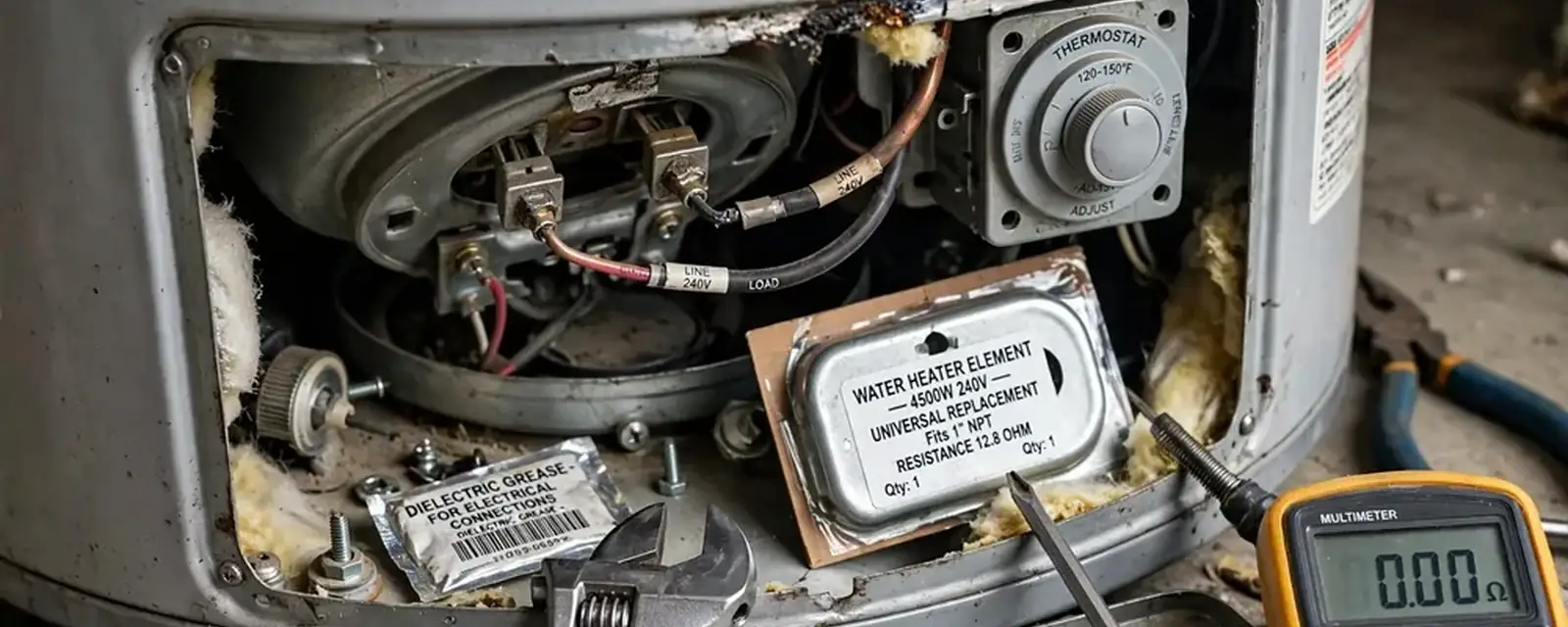
Replacing a water heater heating element is a common repair on electric tank heaters, and it can restore hot water without a new tank. The job is to cut power at the breaker, confirm it is dead, drain the tank below the element, swap the part, refill fully and only then restore power. Gas heaters have no elements, so this guide does not apply to them.
Water and household current are a dangerous pairing. If any step below feels uncertain, stop and call a licensed plumber or electrician. This article explains the process so you can judge the work, whether you do it or someone else does.
First, make sure the element is really the problem
Most electric tanks have two elements, an upper one and a lower one, each controlled by its own thermostat. When one fails, the symptoms differ. If the upper element dies, you usually get no hot water at all. If the lower one dies, you get a short supply of hot water that runs out fast.
Other causes look similar. A tripped breaker, a tripped high-limit reset button, a bad thermostat or a failed wire connection can all cut heat. Check those before buying a part.
| What you notice | Common cause | First check |
|---|---|---|
| No hot water at all | Upper element, upper thermostat, high-limit trip or breaker | Breaker, then the red reset button behind the upper panel. |
| Hot water runs out quickly | Lower element or lower thermostat | Continuity test on the lower element with power off. |
| Water is lukewarm | Partly failed element, sediment, or a low thermostat setting | Thermostat setting and element resistance. |
| Breaker trips again right away | Shorted element or damaged wiring | Stop. Call a pro before resetting again. |
| Rumbling or popping sounds | Sediment baked onto the elements | Plan a flush and inspect the elements. |
Tools and parts you will need
Gather these before you drain anything
Match the label on your heater's data plate. The wrong wattage can overheat the tank or trip the breaker.
- A non-contact voltage tester and a multimeter that reads resistance.
- An element socket wrench sized for the screw-in type, or a wrench for the bolt-in type.
- A replacement element with the same wattage, voltage and mount style as the old one.
- A garden hose long enough to reach a floor drain or the yard.
- A screwdriver, a new gasket if the element uses one, and a flashlight.
The safe order of work
Replace the element in this order
Do not skip or reorder the first three steps.
Never power an element in an empty or partly filled tank
Elements are designed to sit under water. Switching power on while the tank is low can burn out the new element in seconds and can damage the tank. The open hot faucet running a steady stream, with no spitting air, is the sign the tank is full.
After you restore power, give the water time to heat and check the new gasket for drips.
Not comfortable around a live water heater?
Call the 24/7 line. A licensed plumber can test the elements and thermostats and tell you whether a repair or a new heater makes sense.
Smyrna note: your water supply and sediment
Smyrna buys treated water from the Cobb County-Marietta Water Authority, and the city's quality report does not give a hardness figure. That means you cannot assume how fast minerals will coat your elements. A simple test strip from a hardware store tells you, and the Smyrna Utilities Department at 678-631-5338 can answer questions about the supply.
If you find a thick crust on an old element when you pull it, that is a cue to flush the tank and think about its age. Ask the plumber to check the anode rod too.
Follow the heater manufacturer's instructions for element wattage and thread type, since the wrong part can overheat the tank. Water heater work generally falls under the International Plumbing Code (IPC) as adopted in Smyrna with Georgia amendments, though a like-for-like element swap is a maintenance task, so ask the Building Division if you are unsure.
When replacing an element is not worth it
Tank water heaters commonly last about 8 to 12 years. A new element in a tank that is leaking, rusted at the base or past its expected life is a short-term fix. If water pools at the bottom of the tank, an element will not solve it, because the tank itself has failed.
Compare the repair against replacement honestly. A cheap element on a young tank is a good bet. A second element failure on an old tank is often a sign to plan a new unit. Our water heater repair page explains what we check on a service visit, and the water heater replacement page explains how swaps are scheduled.
If the new element fails soon after installation, suspect the cause, not the part. A shorted thermostat, a loose wire or a mismatched wattage will kill replacements one after another. Stop and have the circuit tested rather than buying a third element.
Prevent the next failure
Flush the tank once a year to remove sediment, set the thermostat around 120 degrees and have the anode rod checked every few years. Sediment shortens element life because it traps heat against the metal.
We take water heater calls across Smyrna and the towns on our service area page, including Mableton to the southwest.
Heating element questions
With power off and proven dead, test each element for continuity with a multimeter. An open reading on one element points to that part.
Yes. Many people replace both at once if the heater is a few years old, since the labor of draining and refilling is the same.
You only need to drain until the water level is below the element you are changing. For the lower element that usually means draining most of the tank.
No. Gas heaters use a burner and thermocouple, not heating elements. They need a different kind of repair.
Call the Smyrna Utilities Department at 678-631-5338. Their annual quality report is the source for what the city says about the supply.
Have a plumbing problem right now? The line is open 24/7.
Call (770) 214-4545