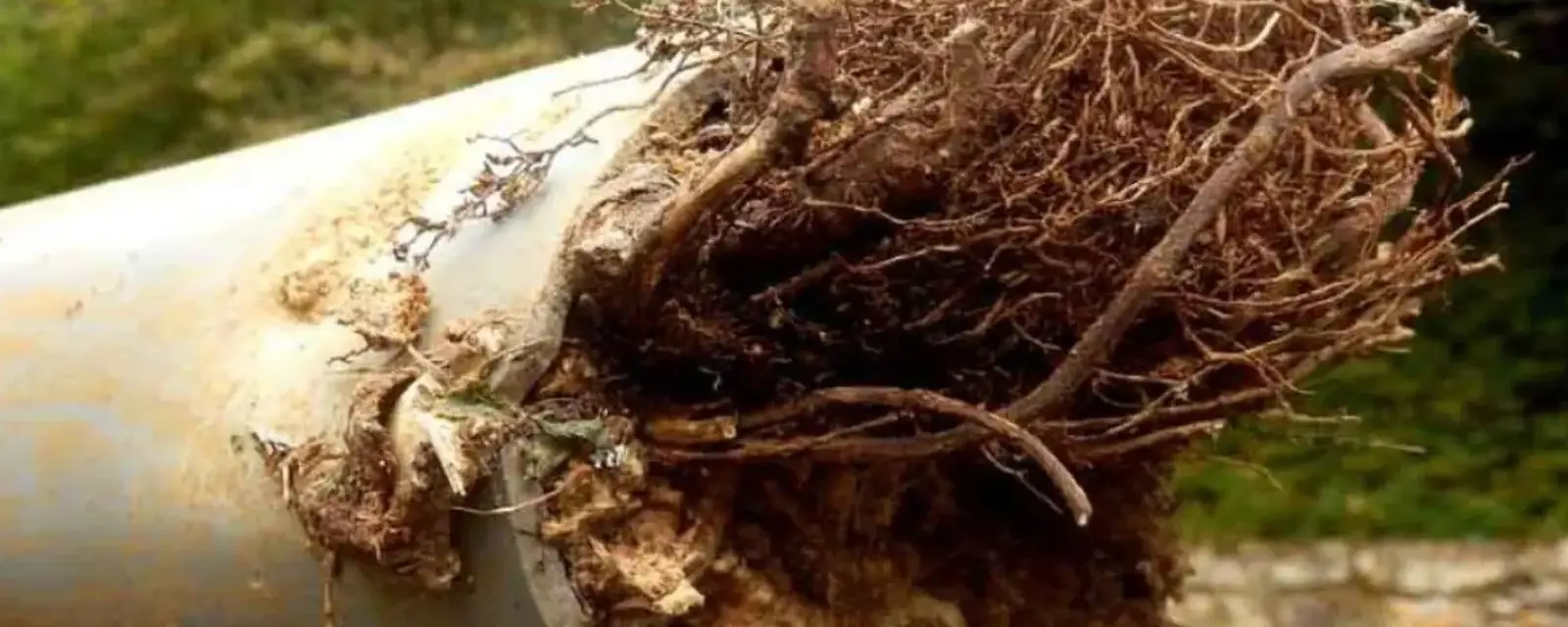
Tree roots in a sewer line repair job come down to one question: can the pipe be sealed, or does it need to be replaced? Roots enter through joints and cracks because the pipe leaks a little moisture, and cutting them out without fixing the opening only buys months. The right fix depends on what a camera shows about the pipe's condition.
This guide explains how roots get in, the warning signs, and how clearing, lining and replacement compare, so you can read a quote with confidence.
How roots get into a sewer line
Roots mostly exploit existing defects. They follow the moisture and nutrients that seep from a small defect, such as an open joint, a hairline crack or a worn connection. Once a thread of root slips in, it grows into a thick mat that catches paper and grease.
Older clay pipe has many joints, and each one is a possible entry point. Cast iron can rust through and crack. Newer plastic pipe has fewer joints and seals better, though a bad connection or a shifted section can still let roots in.
Signs roots may be in your line
- Slow drains that clear and then return within weeks.
- Gurgling in the toilet or tub when another fixture drains.
- Sewer smell in the yard or near a cleanout.
- A soggy or unusually green patch of lawn over the line.
- Backups in the lowest fixtures first, such as a basement floor drain.
Step one is a camera, not a guess
Before any repair, a camera should travel the line so you can see what is actually there. The footage shows roots, their location, the pipe material, cracks, bellies and offset joints. It also shows how far the damage runs, which decides whether a spot repair is enough.
Ask to watch the footage and to get the distance from the cleanout to each defect. Our sewer inspection page explains what we look for and how the pictures are used.
| Option | What it does | Best when | Limit |
|---|---|---|---|
| Cable cutting | Cuts roots out of the pipe | Light growth, short term relief | Roots regrow through the same opening. |
| Hydro jetting | Scours roots and buildup with high-pressure water | Heavier growth in sound pipe | Does not repair the pipe. |
| Spot repair | Digs down and replaces one damaged section | One or two defects | Needs excavation at each point. |
| Pipe lining | Cures a new liner inside the old pipe | Cracks and joints in otherwise intact pipe | Not for collapsed or badly offset pipe. |
| Replacement | Pulls or digs out the old pipe and installs new | Collapsed, bellied or heavily damaged pipe | Highest cost, longest-lasting fix. |
Smyrna note: postwar pipe and what is underground
Smyrna grew from 2,005 residents in 1950 to 19,157 in 1970 after Lockheed reopened the Bell Bomber plant in 1951. Homes of that era commonly have clay or cast iron sewer lines, and clay joints are a classic path for roots. If your house is from that stretch, expect the camera to show an older material.
Before any digging, call Georgia 811, the call-before-you-dig line, so buried utilities are marked. Cobb County treats Smyrna's wastewater, but who owns the stretch between your house and the street varies by property. Call the Smyrna Utilities Department at 678-631-5338 before you pay for a repair you believe is on the city's side.
Georgia 811 is the call-before-you-dig line, and it applies before any trench or spot dig on a sewer lateral. Repairs and replacement follow the International Plumbing Code (IPC) as adopted by Smyrna with Georgia amendments, and the Smyrna Utilities Department at 678-631-5338 can tell you where the city's side of the line starts.
How to choose
A simple way to decide
Let the camera answer these in order.
Cutting the roots is a repair step, not a repair
A plumber who clears roots without telling you about the opening is selling you a recurring visit. Ask what happens after the cut. If the answer is 'call us when it clogs again,' get the camera footage and compare with a second opinion.
That said, cutting is the right first step when a line is backing up and you need relief tonight.
Line backing up with roots in it?
Call the 24/7 line. We clear the line, run a camera and explain whether a repair is needed.
What about the tree?
Removing a tree rarely solves the problem alone. Remaining roots keep growing and the pipe defect is still there. Before you cut a large tree, ask an arborist and the camera footage together. A tree that is far from the line is rarely the culprit, while a thirsty species near the line often is.
If the pipe needs real work, the sewer line repair page explains spot repairs, lining and replacement. Keep a record of every camera pass and repair, because the footage helps the next plumber and any insurer who asks.
Ask whether a repair carries a written warranty and what it covers. A lining or replacement that is guaranteed against root intrusion at the repaired section is worth more than a cut that carries no promise at all. Get the terms in writing before work starts.
Plan for access too. A cleanout near the house makes every future visit faster, and if your line has none, adding one during a repair saves time on each later visit.
Where we work
We handle sewer calls throughout Smyrna and the nearby Cobb County towns on our service area page, and we also cover Mableton just southwest of the city.
Tree root sewer questions
If the opening in the pipe stays, roots usually return. Sealing, lining or replacing the damaged section is what stops them.
Yes, after the roots are cleared, when the pipe is cracked or jointed but still intact. A camera confirms whether lining is possible.
Some products can harm pipe and the environment, and they do not fix the opening. Ask a plumber before using one.
Look for a capped pipe near the house, in the yard or in the crawlspace. Tell the plumber where it is.
Call Georgia 811 before any digging so buried utilities are marked. For questions on who owns the sewer line, call the Smyrna Utilities Department at 678-631-5338.
Have a plumbing problem right now? The line is open 24/7.
Call (770) 214-4545