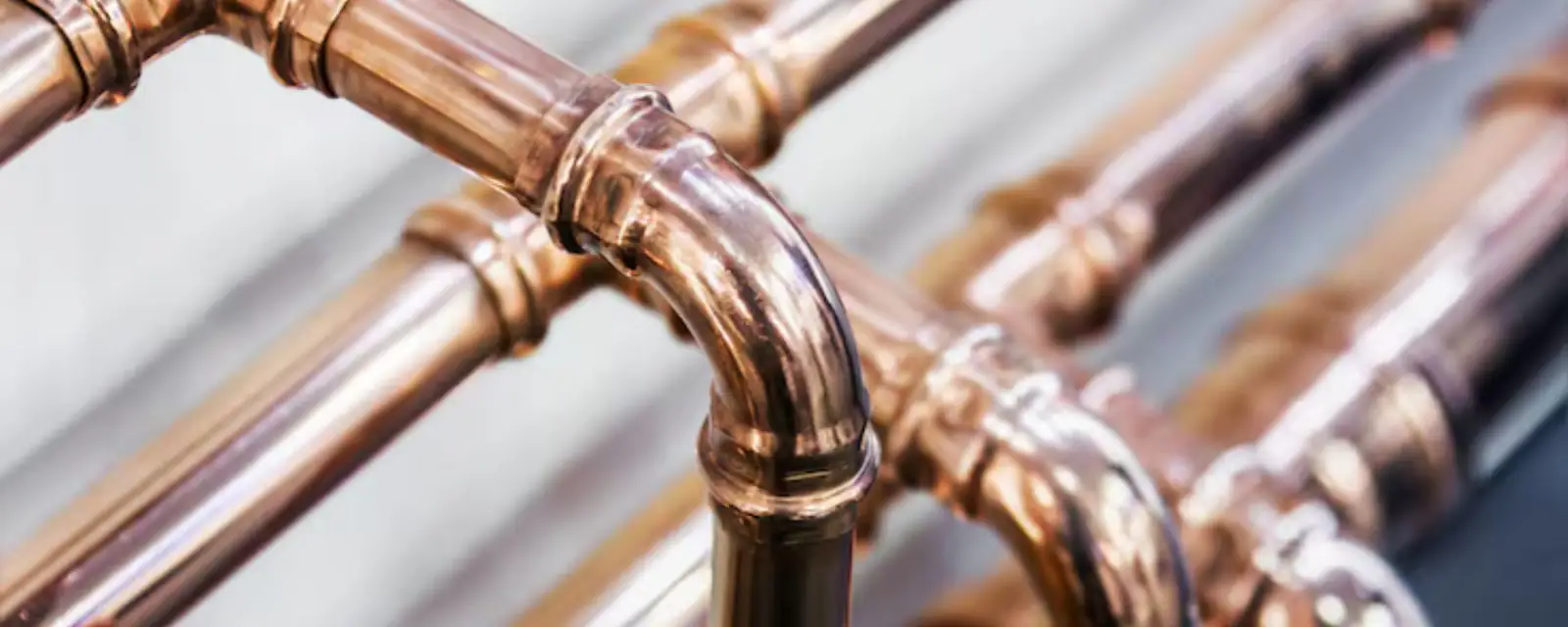
The main types of plumbing fittings in Smyrna, GA homes are elbows, tees, couplings, unions, adapters, reducers, caps and valves. An elbow turns the pipe, a tee splits it, a coupling joins two straight pieces and a union does the same but can be taken apart. Each comes in sizes and materials made to match the pipe it joins.
Knowing these names helps you read a plumber's quote and shop for a repair part. It also helps you see why a small leak at a joint can need a different fix from a leak in the middle of a pipe. This guide covers each fitting, the materials, and a few mistakes to avoid.
The fittings you will see most
Most fittings do one of four jobs. They change direction, split or combine flow, join pipes, or end a line. A good way to read a plumbing diagram is to ask which of those jobs each fitting is doing.
| Fitting | What it does | Typical use |
|---|---|---|
| Elbow (90 or 45 degree) | Turns the pipe | Corners and offsets in supply and drain runs. |
| Tee | Splits flow into a branch | Feeding a fixture off a main line. |
| Coupling | Joins two pieces in a straight line | Repairing a cut or broken pipe. |
| Union | Joins pieces and can be unscrewed | Water heaters and equipment you may remove. |
| Adapter | Joins two different pipe types or threads | Transitions from copper to PEX or to a threaded valve. |
| Reducer or bushing | Steps pipe size up or down | Branch lines and fixture connections. |
| Cap or plug | Closes the end of a pipe | Capping an unused line. |
| Cleanout | Gives access to a drain | Clearing clogs and running a camera. |
Elbows and bends
A 90 degree elbow turns flow sharply and is common in supply lines. In drains, a sharp turn can catch solids, so plumbers use long-sweep elbows or two 45s to ease the turn. That is one reason drains that look fine can still clog at a corner.
A 45 degree elbow turns the pipe gently. Two 45s make a smoother path than one 90. For drains, the smoother path usually wins.
Tees, wyes and combinations
A tee brings a branch off a straight run. In supply lines, a standard tee is fine. In drains, a sanitary tee or a wye lets waste flow from the branch into the main without a sharp turn. A wye with a 45 degree bend is a common choice where a branch drain joins a horizontal line.
Using the wrong tee in a drain is a classic mistake. A flat tee laid on its side can let solids settle and cause repeat clogs.
Couplings, unions and repair fittings
A coupling joins two straight pieces. A union is a coupling you can take apart without cutting the pipe, with a nut that tightens two halves together. Unions are used where you may need to remove equipment later, such as at a water heater.
Repair couplings slip over a cut section so you can fix a pinhole or a break without rebuilding a long run. Push-fit types need no heat or glue. They are handy for quick repairs, but a plumber should judge whether they belong in a hidden location.
How pipe material changes the fitting
Fittings have to match the pipe. Copper uses soldered or press fittings. PEX uses crimp, clamp or expansion rings. PVC and CPVC use solvent cement, and cast iron uses no-hub couplings or lead and oakum joints on very old lines. Mixing materials needs an adapter made for that pair.
Materials that touch drinking water should carry NSF/ANSI 61 marking. Look for it on the fitting or the package. Dissimilar metals, such as copper joined directly to galvanized steel, corrode quickly unless a dielectric fitting separates them.
Smyrna note: older houses mean mixed pipe and mixed fittings
Smyrna's population grew from 2,005 in 1950 to 19,157 in 1970, so much of the housing here comes from the postwar wave. Homes of that era commonly have galvanized steel supply lines, cast iron drains and clay laterals, and many have been patched with copper or PEX over the decades. Each transition between materials is a fitting that has to be chosen on purpose.
That is why a repair in an older Smyrna house can turn into a bigger one. A rusted galvanized elbow may not unscrew, and the pipe behind it may be too thin to thread again. A plumber who looks at both sides of the joint can tell you whether a single fitting will do or the section needs replacing.
Mistakes that cause leaks at fittings
A plumber checks each of these on every job, and you can ask about them.
- Joining copper to galvanized steel without a dielectric fitting.
- Overtightening a threaded fitting until the female end splits.
- Skipping the thread sealant or using the wrong kind for the material.
- Using a drain fitting in a pressurized supply line.
- Leaving a push-fit joint behind a wall without checking it for movement.
Fittings and the fixture connections
Under a sink, you will see a trap with slip-joint fittings, a tailpiece and a drain arm. These use plastic or metal nuts and washers and can leak if they are cross-threaded or the washer is missing. A drip there is a simple tightening fix about as often as it is a part swap.
Behind the toilet, you will see a braided supply line with a compression nut. The right size matters, since a mismatched nut will weep. Our leak detection service helps when a drip appears and you cannot find the joint behind it.
Joint dripping and you cannot tell which fitting it is?
Call (770) 214-4545. A licensed plumber can find the leak and give a clear price before work starts.
When to replace a fitting and when to replace the pipe
A fitting that has failed on an otherwise sound pipe is a quick repair. A fitting failing on corroded pipe is a warning that the pipe is near the end of its life. If one joint has failed, look at the pipe on either side. If it is rusted, flaking or thin, patching just moves the leak.
In those cases our repiping page describes how we replace failing lines with modern pipe, with the right fittings at each transition.
Where we work
We send licensed plumbers across Smyrna and take calls from just southwest, as on our Mableton plumber page. The service area page lists the towns we cover.
Plumbing fittings questions
A coupling joins two pipes and is usually permanent. A union has a nut that lets you take the joint apart without cutting the pipe, so it suits equipment you may remove later.
Yes, with an adapter made for that pairing. Use a fitting that matches both the copper size and the PEX method, such as crimp or expansion rings.
A gentle bend lets solids keep moving. A sharp turn can catch paper and debris and cause repeat clogs.
They are rated for long use when installed correctly, but they can be removed and reused. Many plumbers use them for quick repairs and prefer soldered or crimped joints in hidden locations.
Homes from the 1950s to about 1970 commonly have galvanized supply fittings and cast iron or clay drain joints, often with later copper or PEX patches. Ask your plumber to identify what you have before any repair.
Have a plumbing problem right now? The line is open 24/7.
Call (770) 214-4545