A plumbing fixture is any device that receives water or sends wastewater away, such as a sink, toilet, tub, shower or laundry standpipe. If you live in Smyrna, GA, your house has a handful of them, and each one connects to the supply and drain pipes behind your walls. Knowing which part is the fixture and which is a fitting or an appliance helps you describe a problem clearly and understand a quote.
This guide sorts out the vocabulary, explains the idea of fixture units without any code tables, and walks through a simple way to decide between repairing a fixture and replacing it.
Fixtures, fittings and appliances: three words that get mixed up
People use these words as if they meant the same thing. They do not, and the difference shows up on invoices. A fixture is the visible end point. A fitting is the small connecting part that joins pipe to pipe or pipe to fixture. An appliance is a machine that happens to use water.
| Term | What it does | Examples |
|---|---|---|
| Fixture | Receives water or discharges wastewater where you use it | Kitchen sink, lavatory, toilet, bathtub, shower, laundry tub. |
| Fitting | Joins or redirects pipe, or connects a pipe to a fixture | Elbows, tees, couplings, P-traps, supply lines, shutoff valves. |
| Appliance | A machine that draws water and often drains it | Dishwasher, washing machine, water heater, garbage disposal. |
| Trim | The user-facing parts of a fixture that can be swapped | Faucet handles, shower valve trim, toilet flapper kits. |
That last row matters for cost. Replacing trim on an existing valve is a small job. Replacing the valve body behind the wall is a larger one. A good plumber will tell you which of the two you actually need.
Fixture units, explained without a code book
Plumbing codes rate every fixture by how much load it puts on the system. The rating is called a fixture unit. A bathroom sink counts as a small load. A toilet and a bathtub count as bigger ones, because they move more water in a shorter time.
You never need to do the math yourself. The idea explains why a drain for a tub is larger than a drain for a bathroom sink, and why a house with a new bathroom added may need bigger pipe somewhere upstream. The International Plumbing Code, as adopted by the City of Smyrna with Georgia amendments, is the document inspectors use for those sizing decisions.
What a typical house has, room by room
Count yours before you call. It helps the plumber plan the visit and brings fewer surprises.
- Kitchen: a sink with a faucet, often a garbage disposal, plus a dishwasher connection.
- Bathrooms: a toilet, a lavatory sink, and a tub, a shower or both.
- Laundry: a washer box with hot and cold valves and a drain standpipe.
- Outside: one or more hose bibs, sometimes a frost-proof type.
- Utility space: a water heater and a main shutoff valve.
Smyrna note: fixtures from the postwar building wave
Smyrna had 2,005 residents in 1950 and 19,157 in 1970, after Lockheed reopened the Bell Bomber plant in 1951. Many houses here date from that stretch. If you own one, some of the fixtures, valves or supply lines may be original or from a later remodel, so ask your plumber to look at what sits behind the fixture and not only at the fixture itself.
The City of Smyrna has adopted the 2024 International Plumbing Code (IPC) with Georgia amendments. Permits go through the city's online portal, and the Building Division says projects involving two or more licensed trades need one. The page does not list single fixture swaps, so call the Smyrna Building Division at (678) 631-5387 and ask before a larger remodel.
Repair or replace: how to decide
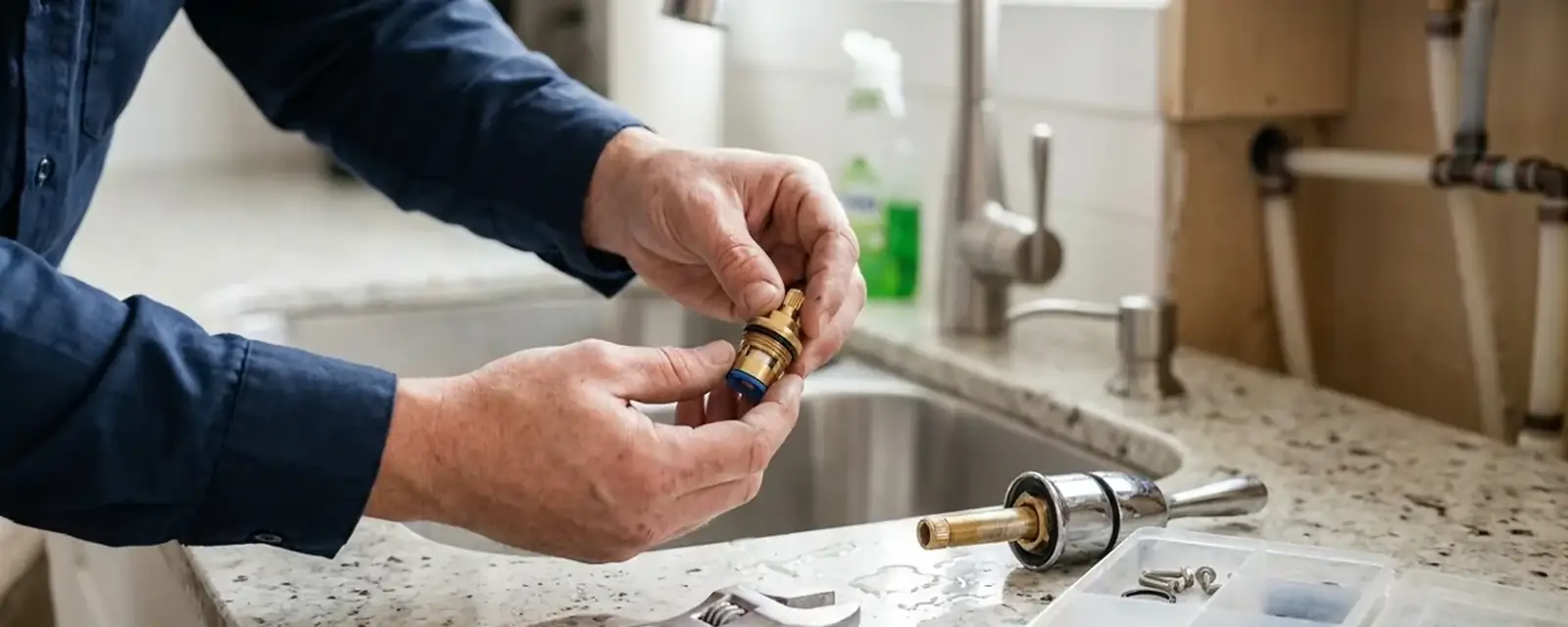
A fixture that works but looks tired usually does not need to go. A leaking faucet often needs a cartridge or seat, not a new faucet. A running toilet often needs a fill valve or flapper. These repairs cost little and restore normal service.
Replacement makes sense when the part is cracked, when repairs keep failing, when parts are no longer made, or when the fixture uses far more water than a modern one. A cracked toilet bowl or a rusted-through sink basin cannot be patched in any lasting way.
Four questions that settle most repair-or-replace calls
Work through these in order before you spend money.
The shutoff valve is part of the decision
Every fixture should have its own shutoff valve so you can stop the water without turning off the whole house. Old valves seize up, and forcing one can break it. If a fixture's shutoff will not close fully or weeps at the stem, replacing it is the right time to do it, because the plumber already has the water off.
If you ever find that a valve will not shut, locate the main shutoff and use that instead. Learn where the main is today, not during a leak.
Not sure what you are looking at?
Describe the fixture and the symptom. We will tell you whether it is a repair, a replacement or a bigger pipe issue.
When the fixture is fine but the plumbing is not
Sometimes the fixture is blamed for a problem that lives in the pipes. A faucet with weak flow may have a clogged aerator, but it may also be on a supply line that has narrowed with age. If several fixtures show low flow together, ask about the supply side, not each faucet.
For a leaking or dripping fixture, our faucet repair page lists the usual causes. For a toilet that runs, rocks or leaks at the base, see toilet repair. Both pages explain what a visit includes.
Where we work
We take fixture and plumbing calls throughout Smyrna and the nearby Cobb County towns on our service area page. If you are on the southwest side, the Mableton plumbing page covers that neighborhood in detail.
Fixture questions homeowners ask
The faucet is a fixture, or part of one, because it delivers water for use. The small parts that connect it to the wall, such as the supply lines and shutoff valves, are fittings.
Most plumbers call it an appliance. It is connected to the plumbing, but it does not receive water for your use at that spot the way a sink does.
Many people swap simple fixtures themselves. Call a plumber if the shutoff valve will not close, if the flange or drain looks damaged, or if the work involves moving pipes.
It varies by material and use. Wear parts inside them, such as washers and cartridges, usually fail long before the fixture body does.
The city's Building Division says projects involving two or more licensed trades need a permit and does not list single fixture swaps. Call (678) 631-5387 to confirm for your job before you start.
Have a plumbing problem right now? The line is open 24/7.
Call (770) 214-4545