The right tankless water heater for a Smyrna, GA home is the one that can heat the most water you will run at one time, from the coldest incoming water of the year, to the temperature you actually use. That sentence contains three numbers: gallons per minute, inlet temperature and outlet temperature. Get them right and the size follows.
Most disappointments with tankless units come from skipping that math. A unit that is too small gives you a hot shower that turns lukewarm when the dishwasher starts. A unit that is far too big costs more and may need a bigger gas line or electrical service than your house has.
Step one: count what runs at the same time
Make a list of every fixture that might be open together on a busy morning. Typical flow figures are about 2 to 2.5 gallons per minute for a shower, about 1.5 for a kitchen faucet, and about 1 to 2 for a dishwasher or washing machine. Your own fixtures vary, and the flow rating is often stamped on the fixture or listed in its manual.
Do not size for the average moment. Size for the peak you are unwilling to compromise on. A couple may only need one shower at a time. A family with teenagers may want two showers and a dishwasher together.
| Household pattern | Fixtures at once | Typical total flow |
|---|---|---|
| One person, one shower | Shower | About 2 to 2.5 gallons per minute. |
| Couple, shower plus kitchen faucet | Shower and faucet | About 3.5 to 4 gallons per minute. |
| Family, two showers | Two showers | About 4 to 5 gallons per minute. |
| Family, two showers plus dishwasher | Two showers and appliance | About 5.5 to 7 gallons per minute. |
Those are typical figures for planning, not promises about any model. Low flow showerheads reduce the total. A rain head or body spray raises it.
Step two: find your temperature rise
Temperature rise is the difference between the water coming into the house and the temperature you want at the tap. A common tap target is around 105 to 120 degrees. The colder the incoming water, the harder the heater has to work, and the lower the flow it can deliver.
We cannot give you a Smyrna inlet temperature, because it changes by season, by pipe depth and by how far the supply line runs. The honest method is to measure it. Run a cold tap for a couple of minutes on a cold morning and read the temperature with a thermometer, then size for that number instead of a guess.
The formula plumbers use
Heat needed equals flow in gallons per minute times 500 times the temperature rise, which gives British thermal units per hour. The 500 comes from water weighing about 8.33 pounds per gallon and 60 minutes in an hour.
A heater rated for the right output at your winter rise will deliver the flow you want. The same heater on a summer day has room to spare. Manufacturers publish charts that show flow at each rise, so ask your plumber to read the chart for the models you are considering.
Gas or electric: the supply decides more than the size
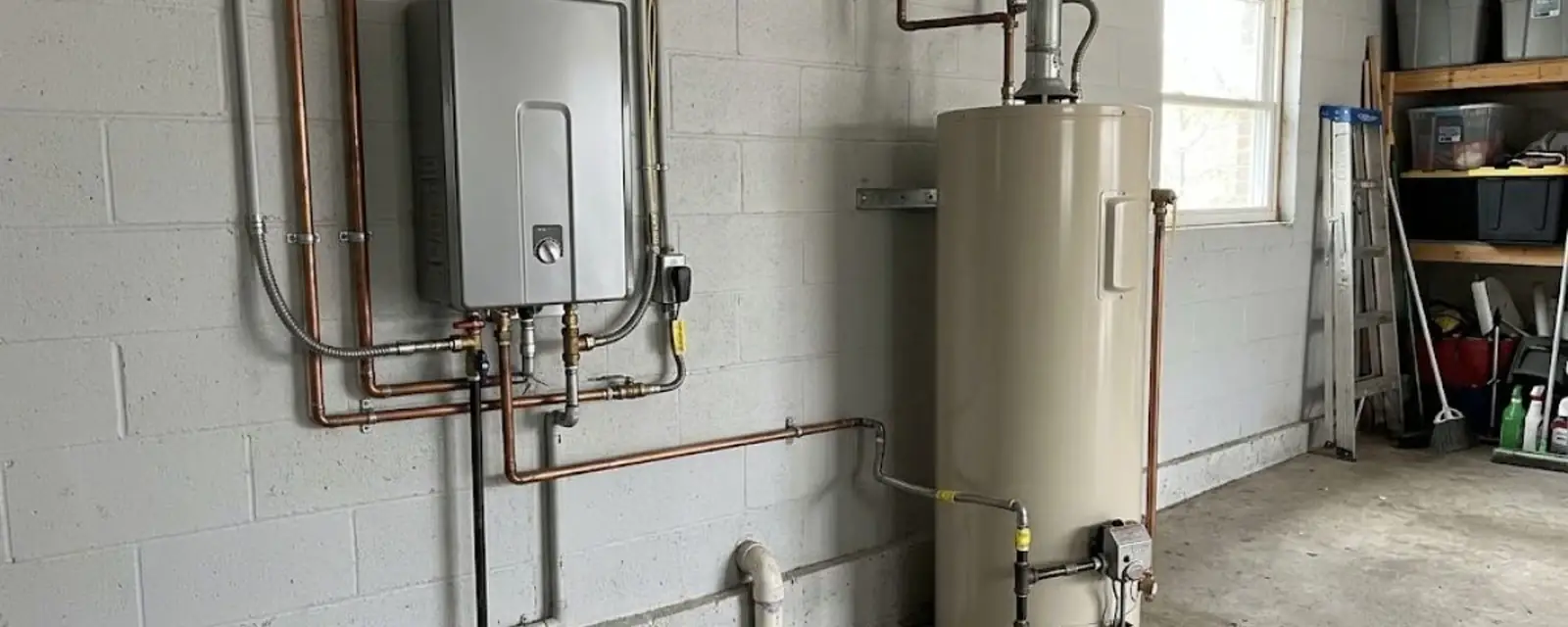
Gas units are rated in British thermal units. They need gas piping that can carry the load of the appliance and everything else on the line, plus special venting. High efficiency models also need a condensate drain. A gas line sized for a small tank heater is often too small for a whole house tankless unit.
Electric units are rated in kilowatts and draw large current. A whole house electric tankless can need more circuit capacity than an older panel can spare. Many homeowners find the panel upgrade costs more than they expected. For wiring questions, hire a licensed electrician.
Smyrna note: what the housing stock and the water supply mean for tankless
Smyrna grew from 2,005 people in 1950 to about 19,000 by 1970 after the Bell Bomber plant reopened under Lockheed. Houses from that postwar wave commonly have gas piping that was sized for a modest tank heater and a stove. Ask your plumber to calculate whether the existing line can carry a tankless unit before you buy one.
Smyrna buys treated water from the Cobb County Marietta Water Authority, and the city's water quality report lists no hardness figure. That is why we say test your tap, or ask the Smyrna Utilities Department at 678-631-5338 about your water. Mineral scale shortens the life of a tankless heat exchanger, so an annual flush is part of owning one.
Permit rules for a change from a tank to a tankless unit are not spelled out on the city's page. The Building Division has adopted the 2024 International Plumbing Code (IPC) with Georgia Amendments, so call (678) 631-5387 to ask if your project needs a permit.
Questions to ask before you buy a tankless unit
Put these in writing with any quote.
- What flow does this model deliver at my coldest incoming water, not at a standard rise?
- Can my gas line or panel carry the load, and what will it cost to upgrade if not?
- Where does the vent run, what material is it, and where does condensate drain?
- Is the plumber licensed in Georgia, and who pulls the permit if one is needed?
- What is the plan for flushing the unit once a year?
Want a size recommendation for your house?
Call (770) 214-4545. We give a clear price before work starts, and we measure before we recommend.
When a tank still makes sense
A tankless heater saves space and delivers hot water until the gas or power stops. It also costs more up front, and it needs maintenance. If your hot water use is light and your tank is young, repairs may be the better choice. Our water heater repair page covers what can be fixed before you replace a tank.
If you decide to move ahead, the tankless water heater service page explains what we install, flush and descale. We will walk your house, check the gas and electrical capacity and give you a plain written price.
Where we work
We cover Smyrna and the neighbors around it, including the Mableton homes covered on our Mableton plumbing page. If you are unsure whether we serve your street, check our service area or call the 24/7 line and ask.
Tankless sizing questions
Many families of four plan for about 5 to 7 gallons per minute if two showers and an appliance can run together. Your fixtures and habits matter, so count your own peak usage rather than relying on a household size chart.
No. A larger unit costs more and may need a bigger gas line, vent or electrical service. The right unit meets your peak demand at your coldest inlet temperature with a little margin.
It will not run out like a tank, but it can fail to keep up if too many fixtures open at once. When demand exceeds the unit's flow at your temperature rise, the outlet water cools.
Heating water by a bigger rise takes more energy per gallon. In winter the same heater delivers fewer gallons per minute than in summer, so size for your coldest water.
The city's water quality report does not list hardness, so we cannot give a figure. Test your tap or ask the Smyrna Utilities Department at 678-631-5338, and plan an annual flush to clear scale.
Have a plumbing problem right now? The line is open 24/7.
Call (770) 214-4545